
Why Cities Feel Impossible for Making Friends
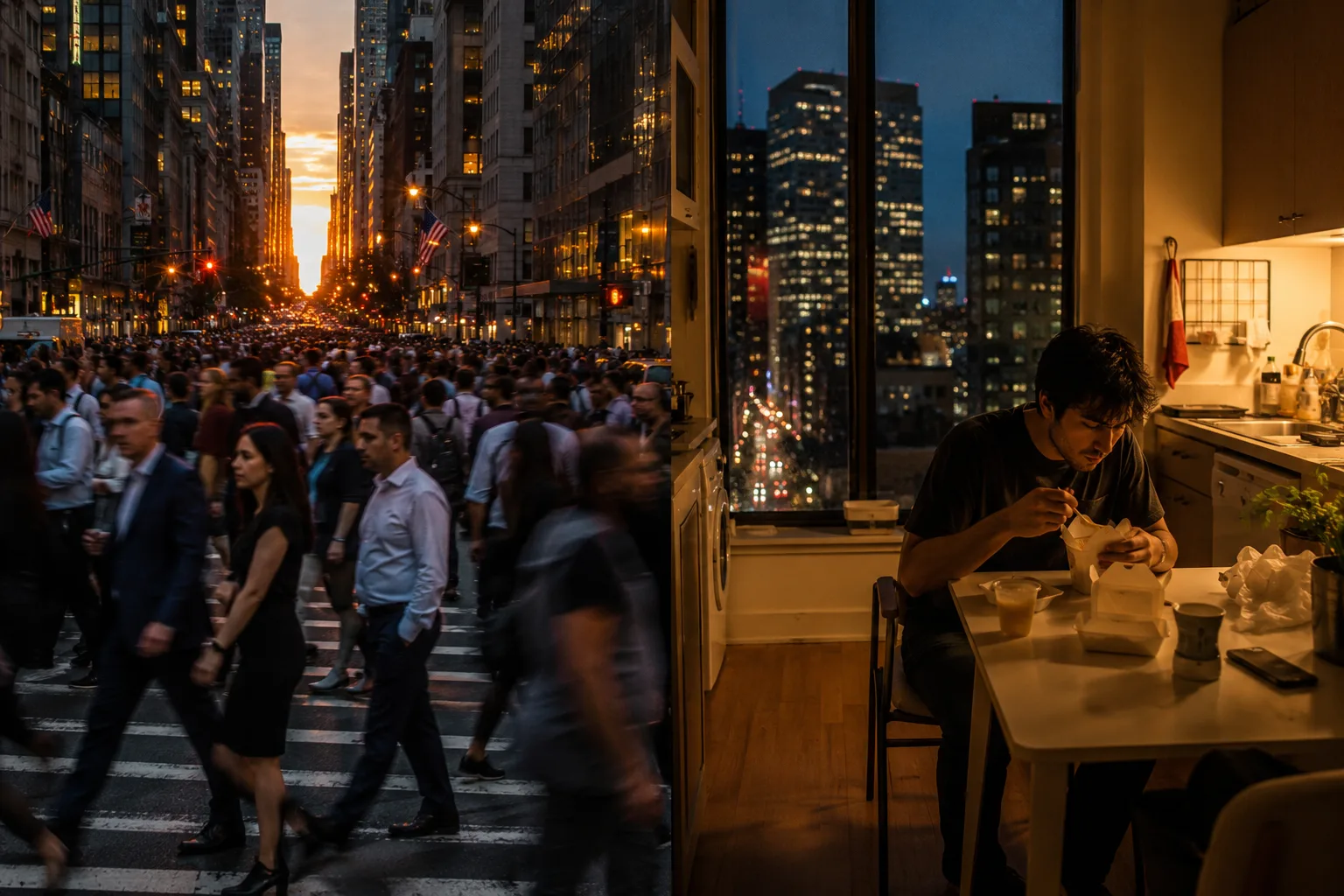
Google “loneliest city in America” and you’ll get Washington, D.C. Google “cities where people feel loneliest” and you’ll get Riverside, California. Open an expat survey and Berlin is literally last place for making local friends.
So which city is actually the hardest for friendship? All of them, depending on what you’re measuring. That’s the part listicles skip. Researchers aren’t ranking the same thing. They’re ranking three different kinds of social friction, and your city might be brutal at one and fine at another.
This post is the map for that mess: which cities show up on which lists, what the science says is going wrong in each type, and how to stop fighting the wrong battle.
Three scorecards, three different questions
Before we name names, you need the scorecards. Otherwise you’ll move to Atlanta because “it’s not D.C.” and wonder why you still feel invisible.
Scorecard 1: Who lives alone?
The Chamber of Commerce ranks “loneliest” cities by one-person households using Census housing data. Living alone doesn’t automatically mean lonely. But when nearly half of every apartment building is a solo lease, the default social setup is isolation. You have to opt into connection. Nobody bumps into you by accident.
Scorecard 2: Who says they feel lonely?
Northwell Health and Stacker ranked the 15 biggest U.S. metro areas using Census Household Pulse data from August through September 2024. This is self-reported: do you feel lonely? Roughly two in five Americans said yes, at least sometimes, putting a huge chunk of the country at higher risk for the health problems loneliness is linked to. Gallup’s 2024 polling found something sharper: one in five U.S. adults felt lonely “a lot of the day yesterday," the highest rate in two years.
Scorecard 3: Can newcomers actually break in?
InterNations surveys thousands of expats in 53 cities worldwide. Their 2024 ranking measures whether locals feel approachable and whether it’s easy to make friends in your new home. This catches cultural freeze cities that domestic rankings miss entirely.
Same word. Three datasets. Three winners.
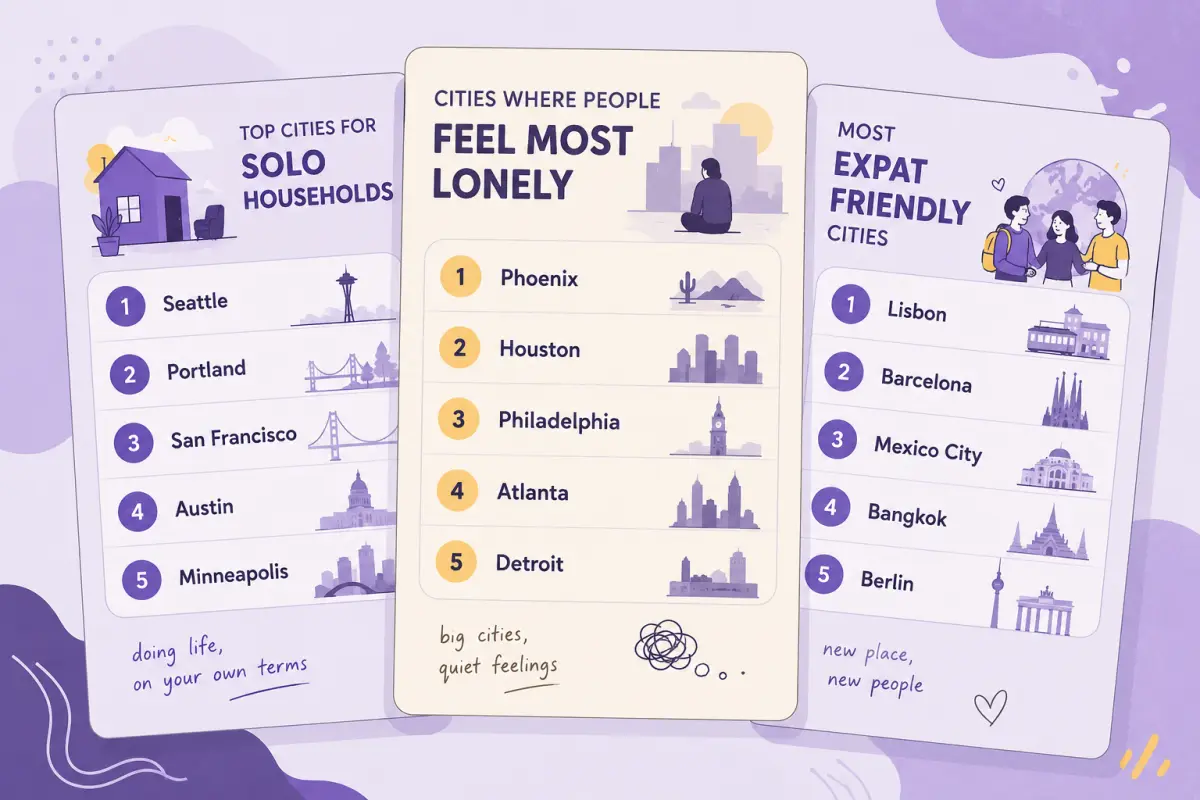
The cities that keep showing up (grouped by what actually breaks)
Forget a single top-10. These are the friction types researchers keep finding, with the cities that embody them.
Type A: Solo-structure cities
Who tops this list: Washington D.C., Birmingham, St. Louis, Atlanta, Cleveland.
D.C. has topped the Chamber of Commerce’s solo-household ranking two years running. Nearly half of households are one person. What’s wild is the age skew: only about 23% of those solo households are 65+. This isn’t a retirement-home city. It’s young professionals in studio apartments, rotating jobs, eating dinner over the sink.
Atlanta lands high on both solo-living data (44.5% of households) and self-reported loneliness in the 2024 Census pulse. Birmingham and St. Louis follow the same pattern: lots of people, lots of front doors that close behind one person.
What’s actually hard here: Nobody’s hostile. The structure just doesn’t hand you a social life. Your building isn’t a village. Your coworkers rotate every election cycle or every job hop. You can go a full week talking to delivery drivers and nobody who’d notice if you disappeared.
Type B: Sprawl-and-stuck cities
Who tops this list: Riverside, Los Angeles, and other car-dependent metros.
Riverside topped the 15-metro loneliness ranking from Census pulse data in 2024. Not L.A. proper. The sprawling inland metro east of it. That’s the clue.
What’s actually hard here: Distance eats repetition. In a walkable neighborhood, you see the same faces at the coffee shop, the dog park, the bus stop. In sprawl cities, every hangout is a 25-minute drive and a parking search. Researchers studying urban loneliness keep finding the same paradox from a 2021 Scientific Reports study tracking people in real time through the Urban Mind app: more crowding and higher population density were linked to more loneliness in the moment, while perceived social inclusivity and contact with nature pulled loneliness down.
Translation: being near people isn’t the same as being included. And if your city makes “let’s grab coffee” a logistics project, the fifth hangout that turns acquaintances into friends never happens.
Type C: Dense-but-anonymous cities
Who tops this list: New York, Boston, Philadelphia, Detroit, Seattle.
These metros scored above the national average for self-reported loneliness in 2024 Census data. Seattle and Detroit were in the top tier alongside Riverside and Atlanta.
What’s actually hard here: You get the crowd without the recognition. Shoulder to shoulder on the train. Eye contact avoided. A hundred people in your building and you know the super’s name maybe. If you’ve felt that specific flavor of invisible, why big cities feel lonelier than small towns breaks down the mechanics. This post is about where that hits hardest, not the full psychology lecture.
Seattle adds a layer almost no housing stat captures: the Seattle Freeze. A 2026 study in the International Journal of Wellbeing found that people who believe the Freeze is real report fewer local friends and weaker belonging. Over 61% of Seattle-area participants had heard of the stereotype. Believing your city is unfriendly doesn’t just describe the problem. It creates it.
A Pemco Insurance survey of Washington and Oregon residents found about 40% said making new friends wasn’t important to them. Whether that’s Nordic-influenced privacy norms or defensive posture, the result for you is the same: fewer people are trying.
Type D: Cultural-freeze cities (the international data)
Who tops this list: Berlin, Munich, Hamburg, Cologne, Frankfurt. Vancouver for overall expat dissatisfaction.
InterNations’ 2024 Expat City Ranking is brutal on Germany. Berlin ranked last out of 53 cities for local friendliness. 64% of expats there disagreed that it’s easy to make local friends, compared to 41% globally. Munich, Hamburg, and Cologne filled out the bottom of the welcome rankings too.
What’s actually hard here: The city looks social from the outside. Clubs, meetups, beer gardens, art openings. But locals often keep their real circle from childhood, and newcomers report a closed-off default. Berlin’s party scene doesn’t fix the Tuesday afternoon problem. You can be surrounded by interesting people and still have nobody to call when your lease stress hits.
Figure out which hardness you’re actually fighting
Same city can score on multiple lists. Atlanta hits solo-structure and self-reported loneliness. Seattle hits anonymous density and cultural freeze. Before you blame yourself, run this:
You’re in a solo-structure city if:
- Your apartment building feels like a hotel
- Coworkers are friendly at happy hour and never seen again
- Weekends default to solo unless you plan something two weeks out
You’re in a sprawl city if:
- Every social plan involves driving and parking math
- You like people you’ve met but see them once a month max
- “Near me” on a map is still 40 minutes
You’re in a dense-anonymous city if:
- You interact with people constantly and feel unseen anyway
- You’ve had a hundred “we should hang out” conversations with zero follow-through
- Your building has 200 units and zero hallway eye contact
You’re in a cultural-freeze city if:
- Locals have friend groups from before you arrived and don’t expand them
- You hear “people here are cold” from everyone, including locals
- Meetup events are full of other transplants, never locals
Most people pick one wrong fix. They join more networking events in a solo-structure city (already plenty of shallow contact). They move to a denser neighborhood in a sprawl city (still can’t get to the fifth hangout). Match the tactic to the friction.
What works depends on the city type (not generic “put yourself out there”)
Solo-structure play: Build artificial repetition. Pick one time-bound thing that forces the same faces weekly: a climbing gym hour, a volunteer shift, a running club that actually runs the same route. You’re manufacturing the small-town grocery-store bump-in that your city doesn’t provide. One slot. Same day. Six weeks minimum before you judge it.
Sprawl play: Stop optimizing for the coolest venue. Optimize for the closest one. A mediocre café five minutes away beats the perfect spot across town because you’ll actually go back. Car culture kills the fifth hangout. Proximity is the whole game.
Dense-anonymous play: Go smaller, not louder. One block. One bodega. One bartender shift. One park bench hour. Familiar strangers are underrated infrastructure. You’re not trying to conquer the city. You’re trying to become a known person in a 400-meter radius.
Cultural-freeze play: Stop waiting for locals to adopt you. Build your transplant layer on purpose. Language exchanges, hobby groups with rotating membership, roommate-adjacent social setups. In Berlin, expats openly say they friend other expats first. That’s not failure. That’s accurate reading of the terrain. And if your weekend plans keep dying in a group chat where nobody shares a timezone or a neighborhood, that’s basically what apps like AskOut are for: you drop into plans that already have a time and a place instead of waiting for eight people to align calendars that were never going to align.
The uncomfortable takeaway
There is no single “hardest city to make friends.” There’s a hardest city for your specific problem. D.C. will wreck you if you expect hallway community. Riverside will wreck you if you don’t account for drive time. Berlin will wreck you if you think the nightlife equals belonging. Seattle will wreck you if you believe the Freeze before you give anyone a chance.
The science isn’t saying you’re unlikable. It’s saying cities are built for work, housing, and traffic first. Friendship is an afterthought you have to engineer on purpose.
So the real question isn’t “did I pick the wrong city?” It’s “which scorecard is my city beating me on, and am I finally playing the right game?”