
Why You Feel Lonelier in a Big City Than a Small Town
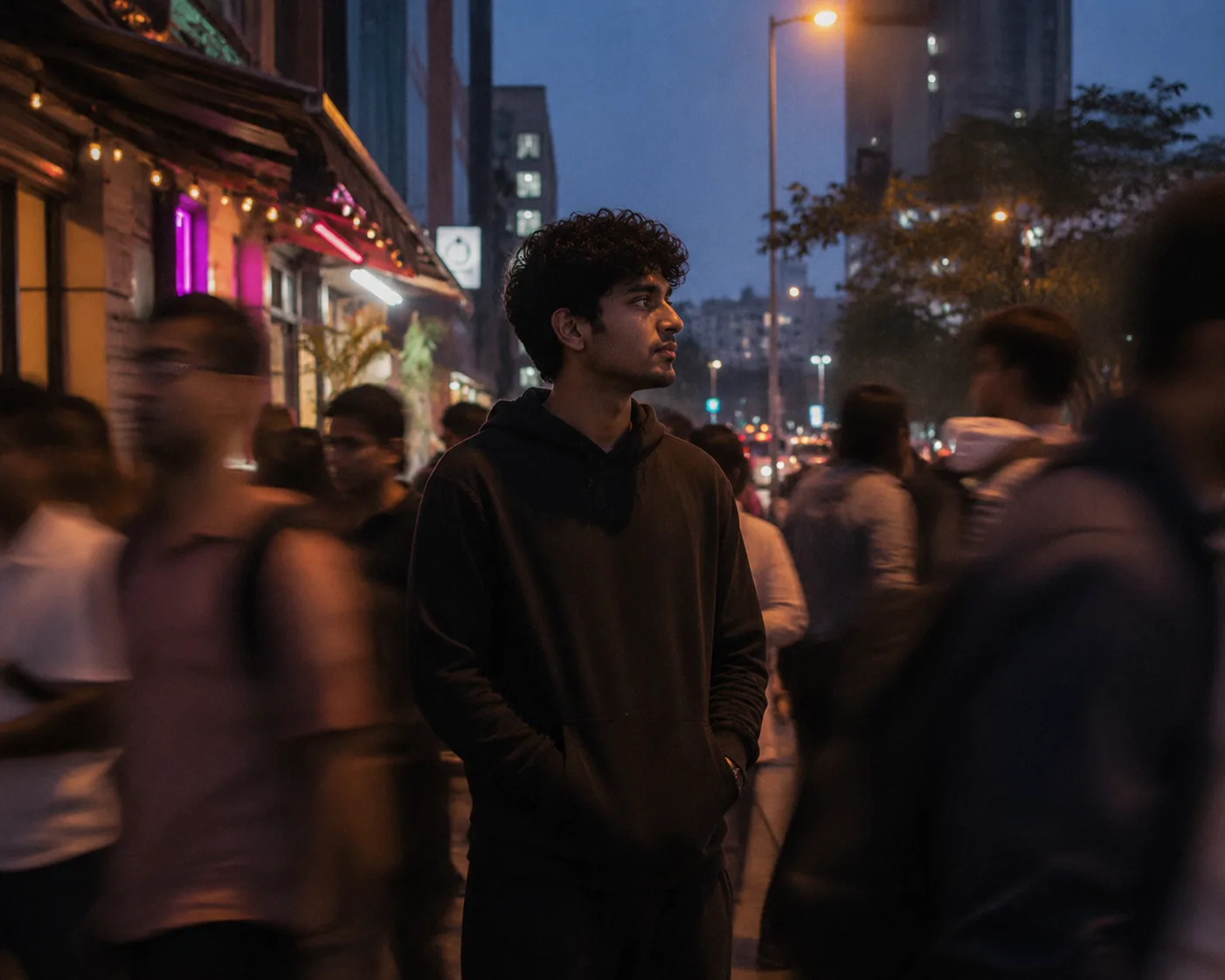
You’re on a packed sidewalk. Shoulder to shoulder. Someone’s backpack hits your arm. A couple walks past laughing about something you only catch the end of. You check your phone like you’re busy. You are not busy. You are standing in a crowd of strangers and somehow feel more alone than you did last summer at your cousin’s wedding in a town with one main street and a gas station that sells fishing bait.
That contradiction has a name researchers keep returning to: the urban loneliness paradox. You can be physically surrounded by millions of people and still feel like nobody would notice if you vanished for a week.
This post is not here to tell you to “put yourself out there.” You already know the advice exists. This is the part nobody explains cleanly: why the big city version of lonely hits different, and why it’s not proof that something is broken inside you.
The numbers are weird, and that’s the point
Start with the part that sounds fake until you see it in study after study.
A 2024 Scottish public health survey found urban residents scored higher on loneliness than rural ones, even when reported social support looked similar. A massive UK Biobank analysis published the same year found the highest loneliness and lowest friendship satisfaction right near city centers. Canadian data from 2022 and 2023 kept showing the same curve: loneliness highest in the biggest cities, tapering as communities got smaller.
Globally, the WHO’s 2025 Commission on Social Connection puts loneliness at roughly one in six people. For Gen Z specifically, Cigna’s 2025 loneliness report had 67% reporting they feel lonely. You’re not imagining a generational mood swing. Young adults in cities are reporting it loudest.
Here’s the counterintuitive bit researchers stress: loneliness is not the same as being alone. Loneliness is the gap between the connection you want and the connection you actually have. A small town can feel suffocating. A city can feel empty. Both can be true for different people. But if you’ve lived in both and the city version stings harder, there’s a reason that goes beyond “you haven’t found your people yet.”
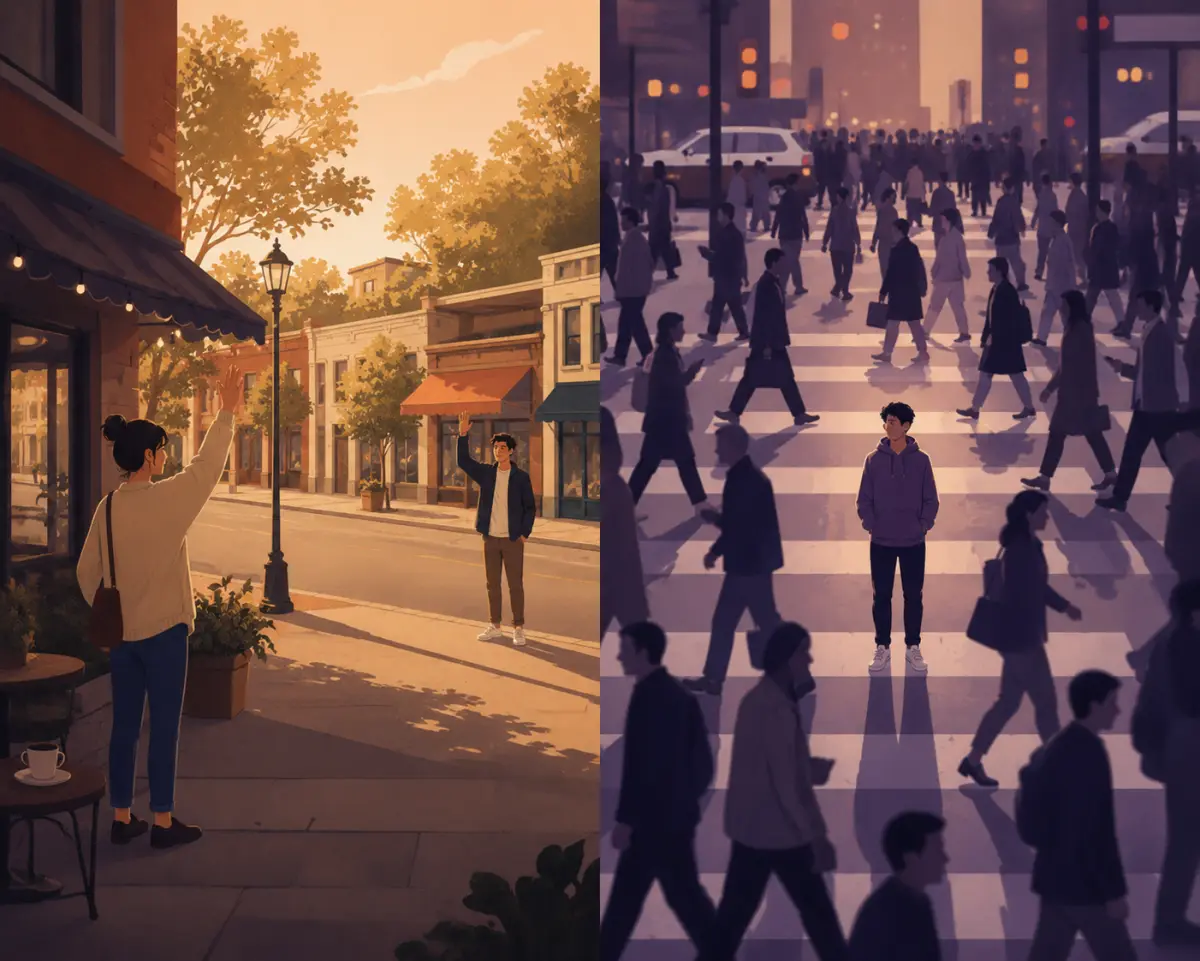
Four mechanics that make cities feel lonelier
Think of this as a diagnosis, not a personality test. Most city loneliness comes from a few structural traps stacking on top of each other.
1. You’re visible everywhere and recognized almost nowhere
Sociologists have been writing about this for over a century. Georg Simmel described city life as a protective “blasé attitude”: you learn not to get involved because getting involved with everyone is impossible. Your brain turns crowds into background noise.
Modern researchers call one piece of this the familiar stranger effect. You see the same barista, the same person on your bus line, the same dog walker in the park. You don’t talk. But in a smaller place, those repeated sightings are the social fabric. A 2024 Brisbane study of nearly 300 residents found that people who regularly encountered familiar strangers in shared spaces reported stronger belonging, even without deep conversation.
In a big city, you get the crowd without the recognition. You’re brushed past, overheard, served. You’re rarely known. Plenty of contact. Not much meaning.
2. Option overload keeps everyone at “maybe later”
Small towns run on repetition. You see the same people at the grocery store, the school pickup, the Friday night spot. Awkward at first. Then it becomes normal. Then it becomes yours.
Cities run on novelty. New restaurant every week. New coworker every quarter. New roommate every lease. The Paris psychology researchers who study urban loneliness put it bluntly: cities offer endless proximity without enough pathways into familiarity. There’s always another plan, another venue, another person to meet. So nothing graduates from “we should hang out” to “I’ll see you there Tuesday.”
Closeness grows from showing up again, not from meeting someone interesting once. Cities are structurally biased toward the first meeting and allergic to the fifth.
3. Your building is designed to hide you from your neighbors
This one is boring and devastating. High-rise living treats hallways, elevators, and lobbies as transit zones. Order delivery. Tap the fob. Disappear behind a door. A 2024 built-environment study tracking young adults through daily life found that loneliness dropped when people walked places, used accessible shared spaces, and weren’t locked in solo apartments all day.
Ray Oldenburg’s old idea of third places still matters: the café, park bench, library corner, bar where you linger without a transaction. Those spaces are thinning. Washington Monthly reported in 2026 that Americans without easy access to gathering spots were more than three times as likely to say they had no close friends at all. Fewer than half said their community even had workable spots to actually gather.
You didn’t fail at community. The infrastructure between home and work got quietly deleted.

4. Comparison is ambient, not occasional
In a town of 8,000, you know who’s doing well and who’s struggling. The range is visible. In a city, you walk past windows full of dinner parties, rooftop drinks, office groups heading somewhere after work. Your brain files every scene as evidence that everyone else got invited to something you didn’t.
Researchers studying the “urban desirability paradox” found that cities attract people for opportunity and density, yet residents near city centers often report worse social satisfaction than people in smaller communities nearby. You’re not weak for feeling that. You’re standing inside a machine built to show you other people’s highlight reels on loop.
What small towns accidentally get right
Nobody needs to romanticize small-town life to learn from it. Rural isolation is real. Some small places are claustrophobic or exclusionary. And when researchers control for age, income, and life stage, geography alone explains less loneliness than you’d think.
But smaller communities often win on one specific layer: emotional loneliness, the ache of not feeling deeply seen. A 2025 Canadian study found emotional loneliness was lower in small towns even when broader social loneliness looked similar. Translation: you might still wish you had more friends, but you’re less likely to feel like a ghost in your own life.
The cheat code isn’t “move back home.” It’s understanding what small towns provide by default:
- Repeated contact without scheduling
- Weak ties that count (the pharmacist who asks about your mom, the guy at the gym who remembers your squat PR)
- Accountability to place (people notice absence)
Cities can replicate those. They just don’t hand them to you. You have to build them on purpose.
Which layer of lonely are you actually in?
Before you overhaul your life, figure out what’s missing. Same word, different problems.
Rate yourself 0 (not at all) to 3 (constantly) on each:
| Signal | What it might mean |
|---|---|
| I talk to people all day but feel unseen when I get home | Recognition problem: lots of contact, no familiarity |
| I have acquaintances but nobody I’d call on a bad Tuesday | Depth problem: weak ties without fringeships upgrading |
| I mostly stay home or WFH and my only outings are errands | Infrastructure problem: no third places in your routine |
| I scroll other people’s plans and feel behind | Comparison problem: ambient proof that everyone else is more connected |
Mostly recognition or infrastructure? Pick one recurring spot and commit to the same time slot twice a week for a month. Not to “network.” To become a familiar face. The same Tuesday morning café. The same Saturday park bench. The same climbing gym hour. Familiarity is a schedule, not a personality trait.
Mostly depth? You don’t need more people. You need one acquaintance to level up. If that sounds familiar, the upgrade path is different from the “meet new people” path. We broke that down in how to turn acquaintances into real friends without the cringe follow-up texts.
Mostly comparison? Log your actual week: who did you speak to, even briefly? Comparison lies because your brain counts their terrace dinner and discounts your coworker lunch, your cousin’s voice note, your roommate’s ten-minute debrief. The gap is often between the life you’re living and the life you’re watching.
If you recently moved and you’re hitting several of these at once, that’s normal. Making friends in a new city is its own beast. This post is why the beast exists.

The part you can actually control this week
You won’t fix urban loneliness with one perfect friendship. But you can stop treating the city like a vending machine for best friends and start treating it like a place that needs routes.
A route is boring on purpose:
- Same walk to the train
- Same corner store
- Same open-mic night or pickup game
- Same hour at the library
Routes create familiar strangers. Familiar strangers create the feeling that you exist inside a social world, not outside it. Researchers call these “fringeships”: more than a wave, less than a group chat. They’re underrated. They keep you from floating.
And when your weekend plans depend on eight people coordinating in a dead group chat, that’s basically what apps like AskOut are for: you join plans that already have a time and a place instead of negotiating for three weeks until everyone flakes.
One route. One recurring spot. One month. That’s not a life hack. It’s how cities stop feeling like a crowd you failed to penetrate and start feeling like somewhere you actually live.
Next time you’re shoulder to shoulder on a sidewalk and still feel invisible, remember: the city isn’t proving you’re unlovable. It’s proving that proximity was never the same as belonging. Belonging was always the slower, repeat-visit kind of work. Small towns just used to do the scheduling for you.